Industrial Nitrogen Generator vs Cylinders & Bulk Nitrogen: A B2B Supply Guide
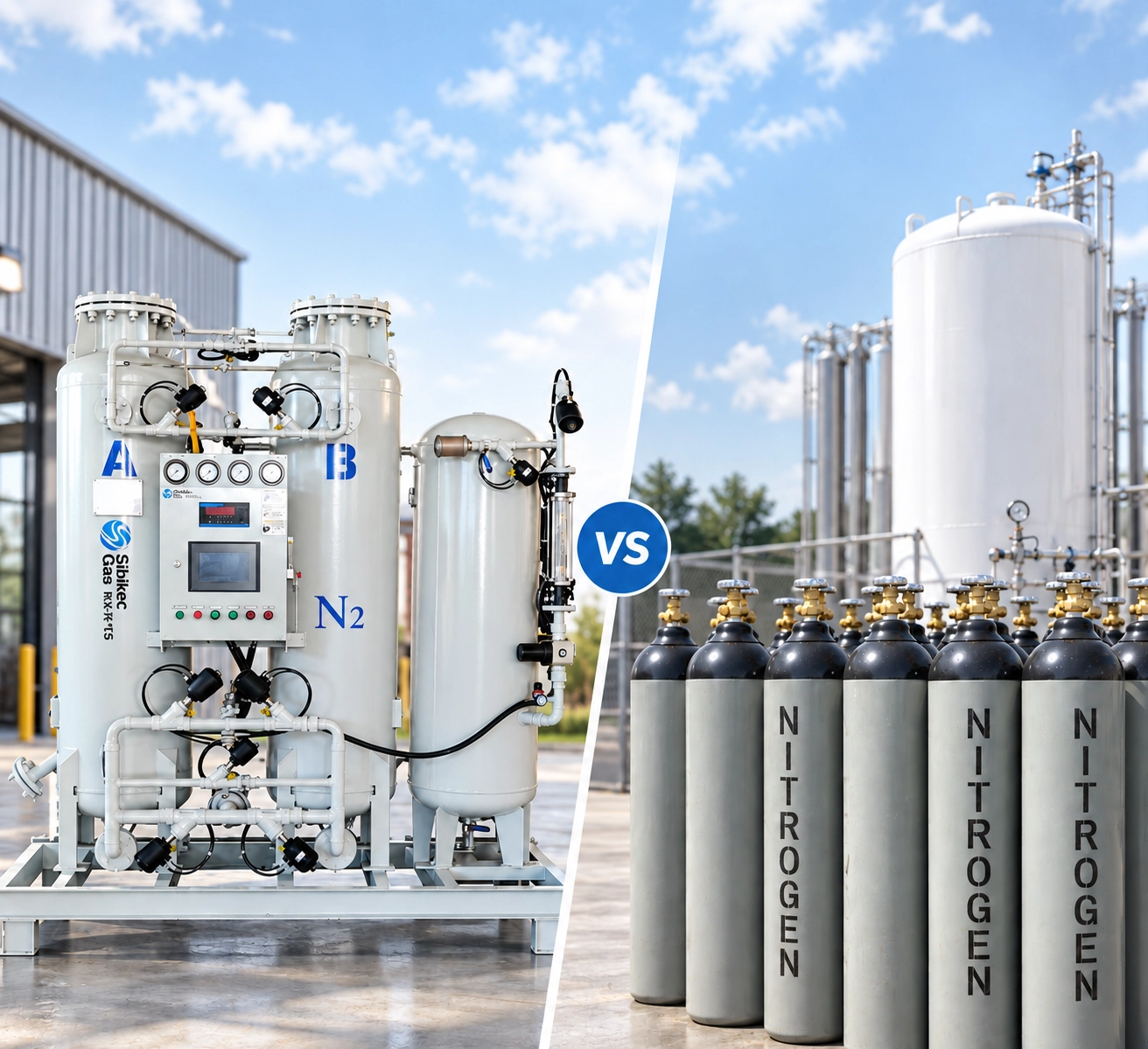
For an industrial business, choosing a nitrogen supply method is not simply a question of buying gas at the lowest unit price.
Nitrogen can arrive in compressed cylinders, be delivered as liquid nitrogen into bulk storage, or be produced at the facility using an industrial nitrogen generator. Each option changes the way a site handles storage, deliveries, equipment, maintenance and supply continuity.
There is no single supply method that is best for every operation. The right choice depends on nitrogen consumption, required purity, pressure, demand pattern, available space, delivery access, existing compressed-air capacity and the consequences of an interruption.
This guide compares the three main nitrogen supply methods from a practical B2B perspective.
Key takeaways
- Cylinders can suit lower, intermittent or changing nitrogen demand without requiring a permanent generation system.
- Bulk liquid nitrogen can support larger and more continuous consumption, but it requires suitable cryogenic storage and delivery infrastructure.
- An industrial nitrogen generator produces nitrogen at the point of use and can reduce dependence on routine nitrogen deliveries.
- PSA and membrane generators separate nitrogen from compressed air in different ways and are not interchangeable for every application.
- Purity, pressure, reliability, maintenance and backup supply matter as much as the headline gas price.
- Businesses should compare total lifecycle cost rather than assuming the cheapest unit price produces the cheapest supply.
Table of Contents
What are the main ways businesses obtain nitrogen?
Industrial users normally obtain nitrogen through compressed cylinders, bulk liquid delivery or an on-site nitrogen generation system.
Each model has different requirements for storage, handling, infrastructure, maintenance and supply continuity.
Compressed nitrogen cylinders
Compressed cylinders provide nitrogen in a portable, high-pressure format. They can be practical when consumption is relatively low, demand is intermittent, or nitrogen is required at several separate points around a facility.
Larger requirements can also be served through cylinder bundles or manifold systems. The main considerations include cylinder handling, storage space, changeovers, regulators, delivery frequency and maintaining sufficient reserve stock.
For businesses comparing capacity and pressure, Northline’s Industrial Gas Cylinder Sizes guide explains the main cylinder-sizing considerations.
Bulk liquid nitrogen
For larger consumption profiles, nitrogen may be transported to the facility as a cryogenic liquid and stored in an appropriate insulated vessel. The liquid is then vaporised when gaseous nitrogen is required by the process.
Bulk supply can reduce the handling associated with large numbers of individual cylinders, but it introduces different infrastructure requirements. These can include storage vessels, vaporisation equipment, safe siting, tanker access, monitoring and scheduled replenishment.
It also remains dependent on external deliveries.
On-site nitrogen generation
An industrial nitrogen generator separates nitrogen from air at the user’s facility instead of storing the full requirement as delivered gas.
The European Industrial Gases Association’s guidance on on-site nitrogen generators for food use describes on-site generation as separating nitrogen from air for direct use at the user location. Two common non-cryogenic technologies are pressure swing adsorption, or PSA, and membrane separation.
Nitrogen generator vs cylinders vs bulk nitrogen
The most suitable option depends on the operating conditions of the individual facility.
| Factor | Cylinders | Bulk liquid nitrogen | On-site generator |
|---|---|---|---|
| Initial site infrastructure | Usually limited | Dedicated storage infrastructure required | Generation equipment and supporting systems required |
| Routine nitrogen deliveries | Yes | Yes | Reduced, although backup supply may still be needed |
| Storage | Cylinder storage area | Cryogenic vessel | Generator and supporting equipment |
| Handling | Cylinder movement and changeovers | Lower routine container handling | Equipment operation and maintenance |
| Purity | Defined by supplied gas specification | Defined by supplied gas specification | Depends on technology, design and operating conditions |
| Maintenance at user site | Generally limited | Storage and vaporisation equipment | Generator, filtration and compressed-air system |
| Demand profile | Often suited to lower or variable demand | Often considered for larger demand | Can suit predictable or continuous demand |
| Supply resilience | Reserve cylinders can be held | Depends on stored inventory and deliveries | Requires maintenance and contingency planning |
These are general characteristics rather than fixed selection rules. A manufacturing plant using nitrogen continuously has a very different supply profile from a workshop using a few cylinders periodically. Consumption should be evaluated together with purity, pressure and process criticality.
How does an industrial nitrogen generator work?
An industrial nitrogen generator takes air from the surrounding environment, conditions and compresses it, then uses a separation process to reduce oxygen and other components while producing a nitrogen-rich gas stream.
The exact process depends on the generator technology.
How does a PSA nitrogen generator work?
PSA stands for pressure swing adsorption. Compressed air passes through vessels containing an adsorbent material, commonly a carbon molecular sieve. Oxygen is preferentially adsorbed while a nitrogen-rich stream continues through the system.
The process operates cyclically. While one vessel produces nitrogen, another can regenerate by releasing the adsorbed gases. This alternating process allows nitrogen to be produced continuously when the system is correctly sized and operated.
PSA performance depends on factors including required purity, flow rate, operating pressure, inlet air quality and system design. EIGA Doc 149/22 covers the safe installation and operation of PSA and membrane oxygen and nitrogen generators.
How does a membrane nitrogen generator work?
Membrane systems also begin with clean, compressed air. The air passes through membrane modules where components of air permeate at different rates.
This produces a nitrogen-enriched product stream while faster-permeating gases are separated and discharged. Purity, flow and efficiency depend on the equipment design and operating conditions.
PSA vs membrane nitrogen generators
Neither technology should be selected from the name alone.
| Consideration | PSA | Membrane |
|---|---|---|
| Separation principle | Adsorption | Selective membrane permeation |
| Compressed air required | Yes | Yes |
| Nitrogen purity | Depends on system design and operating conditions | Depends on system design and operating conditions |
| Flow | Application-specific | Application-specific |
| Feed-air quality | Important | Important |
| Equipment | Adsorption vessels and controls | Membrane modules and controls |
| Maintenance | Filtration and generator components require maintenance | Filtration and generator components require maintenance |
| Selection basis | Purity, flow, pressure, energy and process requirements | Purity, flow, pressure, energy and process requirements |
A business should therefore define the nitrogen specification before deciding on generation technology.
When do nitrogen cylinders make more sense?
Cylinders should not automatically be treated as an outdated supply method. They can remain practical where nitrogen demand is intermittent, relatively small, geographically dispersed within a site or difficult to predict.
They can also avoid the capital investment and maintenance requirements associated with permanent generation equipment.
A proper cylinder cost comparison should consider more than the gas itself. Procurement teams should include cylinder capacity, rental or ownership arrangements, transport, handling, storage, regulators, manifolds and labour associated with changeovers.
For facilities using cylinders, Northline’s Industrial Gas Cylinder Storage guide covers key UK and EU storage considerations.
When does bulk liquid nitrogen make more sense?
Bulk supply becomes worth evaluating when nitrogen demand is large enough that repeated cylinder movements become operationally inefficient.
It can provide a substantial stored nitrogen inventory and reduce frequent cylinder changeovers. However, the decision requires suitable site infrastructure.
- Available space for storage equipment
- Safe tanker access
- Required gaseous flow and pressure
- Vaporisation capacity
- Replenishment frequency
- Monitoring requirements
- Contingency arrangements
- Responsibility for storage equipment and maintenance
There is no universal consumption level at which bulk supply becomes the correct choice. The economics depend on the specific site, supplier, logistics and consumption pattern.
When does on-site nitrogen generation make sense?
On-site generation is worth assessing when nitrogen demand is sufficiently regular and predictable to justify dedicated equipment.
It can reduce routine nitrogen deliveries because the feedstock is atmospheric air. That does not make the nitrogen free.
- Compressed air
- Electricity
- Filtration and air treatment
- Generator equipment
- Monitoring
- Maintenance
- Replacement components
- Suitable ventilation
- Service support
- Backup nitrogen supply
Generator economics should therefore be based on total operating cost rather than simply the absence of cylinder or tanker deliveries.
For a wider view of where nitrogen is used, see Northline’s guide to industrial nitrogen applications and supply. For process inerting specifically, the Nitrogen Purging guide explains common methods and applications.
How much nitrogen purity do you actually need?
Nitrogen purity should be specified according to the process. Higher purity is not automatically better.
Producing or purchasing a tighter specification than the application requires can increase cost without providing a useful process benefit. Welding, laser cutting, food processing, inerting, laboratories and manufacturing processes should not be assumed to require the same grade.
Before selecting a supply system, define the required nitrogen concentration, permitted impurities, pressure, average flow, peak demand and any applicable regulatory or customer requirements.
Northline’s Gas Purity Grades guide explains terms such as 4.5, 5.0 and 6.0 in more detail. Buyers using nitrogen as a laser assist gas can also refer to Nitrogen vs Oxygen for Laser Cutting.
What really determines the cost of nitrogen supply?
Comparing nitrogen supply methods using only the quoted gas price can give a misleading result.
Cylinder supply costs can include
Gas, cylinder rental or ownership, transport, regulators, manifolds, storage space, handling and labour associated with cylinder changes.
Bulk supply costs can include
Delivered nitrogen, storage infrastructure, vaporisation, site requirements, scheduled deliveries, monitoring and contingency stock.
On-site generation costs can include
Generator purchase or financing, compressor capacity, electricity, filtration, maintenance, consumables, servicing, monitoring and backup supply.
The correct comparison is therefore the total cost of delivering the required nitrogen specification to the process reliably.
How much does a nitrogen generator cost?
There is no meaningful universal price for an industrial nitrogen generator.
The required investment depends on nitrogen flow, purity, outlet pressure, generator technology, compressed-air capacity, air treatment, installation, redundancy and control requirements.
Businesses evaluating generation should request a system proposal based on measured or accurately estimated consumption rather than selecting equipment from headline capacity alone.
What happens if an on-site nitrogen generator stops?
This question should be considered before installation, not after a failure.
A generator reduces dependence on delivered nitrogen, but it introduces dependence on mechanical equipment, electricity, compressed air and maintenance.
For a process where nitrogen loss could stop production or compromise product quality, contingency planning may include reserve cylinders, an alternative nitrogen connection, redundant generation capacity, preventive maintenance, critical spare parts, remote monitoring or temporary supply arrangements.
The correct level of backup depends on the operational impact of losing nitrogen.
Can an on-site generator produce food-grade nitrogen?
Potentially, but nitrogen does not become food grade simply because it has been generated on site.
EIGA Doc 194/24 provides specific guidance for on-site nitrogen generators used in food applications. It covers PSA, membrane and cryogenic systems as well as areas such as hazard analysis, traceability, product analysis, maintenance and quality controls.
When nitrogen is used as the food additive E941 in the European Union, Commission Regulation (EU) No 231/2012 specifies an assay of not less than 99% and also sets limits for specified impurities.
A headline nitrogen concentration alone therefore does not demonstrate suitability for a food application.
Northline’s Food Grade Nitrogen (E941) guide explains food-gas purity and modified atmosphere packaging requirements in more detail.
What are the safety considerations for nitrogen generators?
Nitrogen is non-flammable, but it can create a serious hazard if it displaces oxygen in an enclosed or poorly ventilated area.
EIGA Doc 149/22 identifies oxygen-deficient atmospheres among the principal hazards associated with PSA and membrane nitrogen generators. It also addresses hazards including pressure, electrical equipment, rotating machinery and noise.
Generator installations therefore need to consider the complete system, including ventilation, exhaust location, oxygen-deficiency risk, compressed-air equipment, pressure systems, electrical equipment, maintenance access, monitoring, operating procedures and personnel training.
EIGA also makes clear that general guidance does not replace sound engineering judgement, equipment manufacturer instructions or applicable national and local requirements.
How should a business choose its nitrogen supply method?
Start with the process rather than the delivery format.
- Required purity: What specification must the nitrogen actually meet?
- Average consumption: How much nitrogen does the process use under normal operation?
- Peak demand: Can the proposed system meet short periods of higher consumption?
- Pressure: What pressure is required at the point of use?
- Demand pattern: Is nitrogen required continuously, intermittently or seasonally?
- Site infrastructure: Is suitable compressed air, electrical capacity, storage space or tanker access available?
- Supply resilience: What happens if a delivery is delayed or generation equipment becomes unavailable?
- Maintenance capability: Can the business maintain the equipment internally or through a service agreement?
- Quality requirements: Does the application require controlled impurities, traceability or food-grade documentation?
- Lifecycle cost: What will the complete system cost over its operating life?
Only after these questions are answered does it become useful to compare cylinders, bulk supply and on-site generation commercially.
Frequently asked questions
What is an industrial nitrogen generator?
An industrial nitrogen generator is equipment that separates nitrogen from air at the user’s site. PSA and membrane systems are common non-cryogenic technologies. The appropriate system depends on required flow, purity, pressure, site infrastructure and process needs.
Do nitrogen generators need compressed air?
PSA and membrane nitrogen generators use compressed air as their feed gas. The compressed-air system and air treatment are therefore part of the overall generation system and should be included when assessing capacity, energy use and maintenance.
Can a nitrogen generator replace cylinders?
It can replace some or most routine cylinder consumption where the generator can reliably meet the required flow, pressure and purity. Critical processes may still need cylinders or another source as backup.
Is a nitrogen generator always cheaper than delivered nitrogen?
No. The economic result depends on consumption, electricity, compressed-air efficiency, required purity, maintenance, equipment cost, delivery costs and the value of backup supply. A site-specific lifecycle comparison is more useful than a general rule.
Choosing a nitrogen supply model for your operation
Cylinders, bulk liquid nitrogen and industrial nitrogen generators solve different supply problems.
Cylinders can provide flexibility with relatively little permanent infrastructure. Bulk liquid nitrogen can support larger demand while maintaining a delivered product specification. On-site generation can reduce routine delivery dependency when a facility has predictable demand and suitable infrastructure.
The best option is therefore not the one with the most impressive headline specification. It is the supply model that delivers the required nitrogen purity, pressure and flow reliably, safely and at an acceptable total lifecycle cost.
Northline Distribution supports B2B customers with technical gas supply across European markets. If you are reviewing an industrial gas requirement, contact Northline for a quote with your gas, purity, quantity and delivery requirements.