Transporting Gas Cylinders: UK & EU ADR Requirements for Businesses
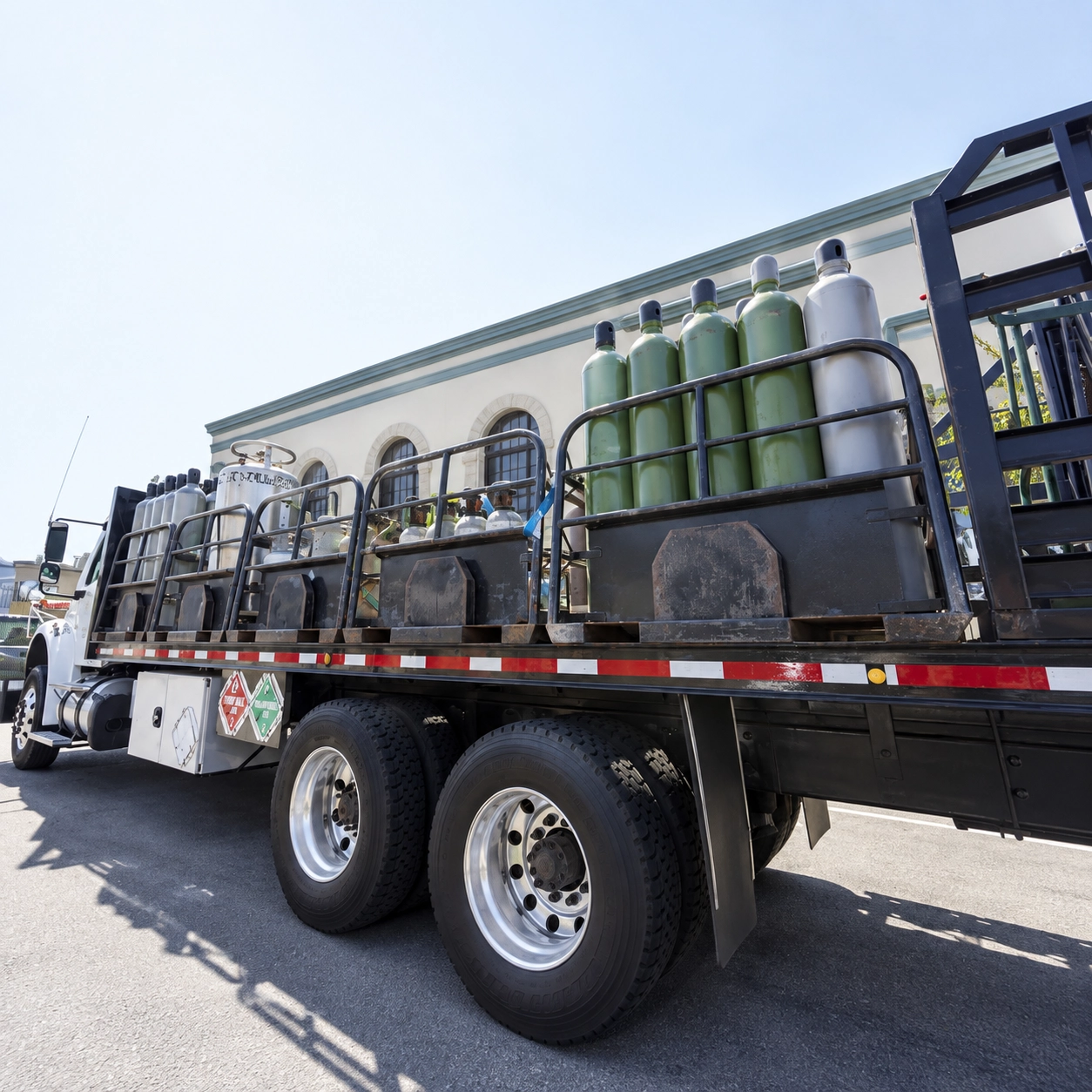
Transporting gas cylinders for work involves more than loading cylinders into a van or lorry.
Gases subject to ADR are covered by the Class 2 provisions, with the applicable requirements depending on the specific gas, quantity and transport operation. Businesses involved in carriage may have responsibilities covering identification, loading, restraint, ventilation, documentation, training and vehicle suitability.
In Great Britain, the Carriage of Dangerous Goods and Use of Transportable Pressure Equipment Regulations 2009, known as CDG 2009, implement ADR 2025 with a number of exceptions and national arrangements. Northern Ireland operates under separate dangerous-goods carriage regulations. Within the European Union, ADR works alongside Directive 2008/68/EC and applicable national provisions.
The practical point for businesses is simple. The correct transport approach should be based on the gas, quantity, cylinder type, vehicle and journey rather than a universal cylinder-count rule.
Key takeaways
- Transporting gas cylinders for work can bring responsibilities under ADR and national dangerous-goods legislation.
- Great Britain currently implements ADR 2025 through CDG 2009.
- Northern Ireland has separate carriage regulations and should not automatically be treated as legally identical to Great Britain.
- ADR small-load provisions depend on transport category and quantity, not simply the number of cylinders.
- Cylinders should be correctly identified, checked before loading and secured against movement.
- Vehicle ventilation is an important consideration when cylinders are carried in enclosed vehicles.
- Cylinders described as empty may still contain residual gas and remain subject to dangerous-goods requirements.
- Documentation, driver training, equipment and vehicle requirements depend on the particular transport operation.
Table of Contents
What rules apply when transporting gas cylinders?
ADR provides the principal international framework for transporting dangerous goods by road.
Its structure covers classification, dangerous-goods lists, packing, consignment procedures, loading, unloading, handling, vehicle equipment, crew responsibilities, driver training and vehicle approval.
For a business transporting gas cylinders, the first question should therefore not be how many cylinders fit in the vehicle.
The business should first establish the gas or gas mixture being carried, its UN transport information, its hazard classification, the quantity being transported, the cylinder type, whether other dangerous goods are being carried at the same time and whether an exemption applies.
The countries involved in the journey also matter because domestic provisions and permitted derogations can differ.
A cylinder’s written identification and transport information should be checked before carriage. Colour alone should not be used as the sole method of identifying the contents.
Northline’s Gas Cylinder Identification guide explains product labels, UN numbers, hazard labels, permanent markings and cylinder colour coding in more detail.
Transporting gas cylinders in Great Britain
For England, Scotland and Wales, CDG 2009 provides the domestic legal framework for dangerous-goods carriage.
The Health and Safety Executive confirms that the regulations currently implement ADR 2025 with a number of exceptions. Great Britain also has approved derogations and domestic provisions that can affect particular movements.
ADR responsibilities extend beyond the person driving the vehicle.
Depending on the transport operation, participants can include the consignor, carrier, packer, filler, loader and unloader. Businesses should therefore consider dangerous-goods requirements when the consignment is planned, not only when the vehicle leaves the site.
A transport arrangement that is suitable for one gas or quantity may not be suitable for another.
What about Northern Ireland?
Northern Ireland should not automatically be treated as legally identical to Great Britain for dangerous-goods transport.
The Carriage of Dangerous Goods and Use of Transportable Pressure Equipment Regulations (Northern Ireland) 2010 provide the separate Northern Ireland framework.
Businesses moving gas cylinders into, out of or within Northern Ireland should confirm the current requirements that apply to the actual journey rather than relying only on Great Britain guidance.
This distinction becomes particularly important when transport routes cross jurisdictions.
Transporting gas cylinders in the EU
Within the European Union, Directive 2008/68/EC covers inland transport of dangerous goods by road, rail and inland waterway within or between Member States.
For road transport, the Directive applies the ADR framework.
The current consolidated version of the Directive is dated 12 May 2026. It also allows certain national provisions and authorised derogations.
That means a common ADR framework exists across EU road transport, but businesses should not assume that every domestic movement is treated identically in every Member State.
For international gas-cylinder movements, the full journey should be considered, including the countries of dispatch, transit and destination.
Does ADR apply when only a few gas cylinders are transported?
It can.
ADR 1.1.3.6 provides exemptions related to the quantity of dangerous goods carried per transport unit. These are commonly referred to as small-load provisions.
The relevant threshold depends on the transport category assigned to the dangerous goods and the quantity carried.
For mixed loads, aggregation rules can also apply.
This is why statements such as “you can carry X cylinders without ADR” are unreliable.
Two vehicles carrying the same number of cylinders can have different regulatory outcomes if the gas classifications or quantities are different.
Being below the applicable small-load threshold also does not remove every responsibility.
In Great Britain, HSE guidance states that remaining obligations can include general dangerous-goods training, appropriate fire-extinguisher provision and proper stowage.
A business should therefore determine the correct transport category and quantity before deciding which requirements apply.
What should be checked before loading gas cylinders?
Cylinder and vehicle checks should take place before loading.
The purpose is to confirm that the cylinders are correctly identified, suitable for carriage and able to be transported without unnecessary risk.
| Check | Why it matters |
|---|---|
| Gas identity | Confirms the correct gas or mixture is being transported |
| UN and hazard information | Supports correct dangerous-goods classification |
| Cylinder condition | Helps identify significant damage or corrosion |
| Valve condition | Helps reduce risks associated with damaged or incorrectly prepared valves |
| Leakage | A leaking cylinder should not enter normal transport |
| Inspection status | Helps establish whether the cylinder remains suitable for transport |
| Labels and markings | Provide product, hazard and transport information |
| Vehicle suitability | Confirms the vehicle can safely accommodate the intended load |
| Load restraint | Prevents cylinder movement during braking, cornering and normal travel |
| Ventilation | Helps reduce the risk of released gas accumulating in an enclosed area |
Businesses handling several cylinder types should not rely on body or shoulder colour alone when preparing a consignment.
The written label and associated transport information should remain the primary reference for identifying the contents.
How should gas cylinders be secured during transport?
Gas cylinders should be restrained so they cannot move during transport.
The securing method needs to be appropriate for the cylinder format, vehicle and load arrangement.
Other items within the load should also be secured so that they cannot strike or damage the cylinders while the vehicle is moving.
Cylinder orientation can depend on the product and package design.
For example, some cylinder types require particular attention to orientation because of the way the contents are stored or because of their safety devices.
For this reason, neither “all cylinders should always be transported horizontally” nor “all cylinders should always be transported vertically” is a reliable universal rule.
Businesses should use the requirements appropriate to the specific cylinder and gas.
Cylinder dimensions and gross weight also affect loading and vehicle decisions. Northline’s Industrial Gas Cylinder Sizes guide explains the difference between physical dimensions, water capacity, filling pressure, nominal contents and gross weight.
Why is vehicle ventilation important?
A gas release inside an enclosed vehicle can create a dangerous atmosphere.
Depending on the product, a leak can reduce oxygen concentration, increase fire or combustion risk, introduce a flammable atmosphere or create a toxic hazard.
BCGA recommends open vehicles, open containers or trailers for gas-cylinder transport where appropriate.
Where an enclosed vehicle is used, its suitability should be assessed and suitable controls should be implemented.
Ventilation should not be considered only while the vehicle is moving. The possibility of a gas release while the vehicle is stationary also needs to be considered.
Modern vehicles can be relatively well sealed, so it should not be assumed that an enclosed van automatically provides sufficient natural ventilation.
If cylinders are transported in an enclosed vehicle, they should be unloaded promptly when the journey is complete and should not be left in an unventilated enclosed space.
Vehicle choice should therefore reflect the gas carried, load configuration, ventilation, separation from occupants and consequences of a possible release.
Cylinder labels and transport identification
Correct identification supports both safe handling and dangerous-goods compliance.
Cylinder information can include the gas or mixture identity, UN number, hazard labels and other transport information.
Permanent cylinder markings relate to the pressure receptacle itself and should not be confused with the information identifying the gas inside.
This distinction matters when businesses receive cylinders from different suppliers or move them between different European markets.
Northline’s Gas Cylinder Identification: Colour Codes, Labels & Markings in the UK and Europe guide covers identification in detail and should be used alongside this transport guide.
What documentation and training may be required?
The requirements depend on the consignment and the exemptions that apply.
For packaged dangerous goods above the applicable small-load threshold, HSE summarizes the driver-training requirement as general training plus an ADR training certificate.
For packaged dangerous goods under the small-load threshold, general training under ADR Chapter 1.3 still applies.
Training responsibilities are not limited to the driver.
People whose work concerns dangerous-goods carriage should receive training appropriate to their responsibilities.
Businesses should also establish whether they need to appoint a Dangerous Goods Safety Adviser, commonly referred to as a DGSA.
ADR requires many businesses involved in dangerous-goods carriage activities to appoint a DGSA, although exemptions exist.
The answer should be based on the organisation’s actual activities and the transport operation rather than company size alone.
Are empty gas cylinders still dangerous goods?
An operationally empty cylinder is not necessarily free from dangerous-goods requirements.
A cylinder may still contain residual gas or pressure even when no useful product can be withdrawn by the customer.
Dangerous-goods guidance distinguishes between ordinary emptied receptacles and situations where the hazard has genuinely been removed.
This is particularly important for return logistics.
Used cylinders should not automatically be treated as ordinary empty metal containers simply because they are being returned to a supplier.
Once cylinders arrive at their destination, transport controls also connect with storage controls.
Northline’s Industrial Gas Cylinder Storage guide separately covers ventilation, segregation, security, stability and other site-storage considerations.
A practical transport check for businesses
Before arranging a commercial cylinder movement, establish what gas is being transported, the relevant UN and hazard information, the quantity, the applicable transport category and whether any exemption applies.
The business should then check cylinder condition, vehicle suitability, ventilation, load restraint, required equipment, training and documentation.
For international movements, the requirements of the relevant jurisdictions should be considered across the full route.
This approach is more reliable than beginning with a cylinder-count rule and trying to determine compliance afterwards.
Frequently asked questions about transporting gas cylinders
Can you transport gas cylinders in a van?
Potentially, but the suitability of an enclosed van should be assessed.
BCGA recommends open vehicles, open containers or trailers where appropriate. If an enclosed vehicle is used, ventilation and other controls should be considered through an appropriate risk assessment.
How many gas cylinders can you transport without full ADR requirements?
There is no reliable universal cylinder-count limit.
ADR small-load provisions depend on the applicable transport category and quantity of dangerous goods carried. Mixed dangerous-goods loads can also require an aggregation calculation.
Do gas cylinders need to be secured in a vehicle?
Yes.
Gas cylinders should be restrained so they cannot move during transport. The suitable restraint method depends on the cylinder, vehicle and load arrangement.
Do empty gas cylinders still count as dangerous goods?
They can.
An empty cylinder may still contain residual gas and can remain subject to dangerous-goods requirements. Its transport status should be established rather than assumed from the fact that it no longer provides usable gas.
Where does ADR apply in Europe?
ADR is an international road-transport agreement used by its contracting parties.
Within the European Union, Directive 2008/68/EC applies the ADR road-transport framework while allowing certain national provisions and authorised derogations.
Businesses should therefore check ADR together with the national requirements that apply to the journey.
Does every driver transporting gas cylinders need an ADR certificate?
No.
For packaged dangerous goods above the relevant small-load threshold, an ADR training certificate will generally be required in addition to general training.
For packaged dangerous goods carried under the small-load provisions, appropriate general dangerous-goods training still applies.
The actual load and applicable exemption should be checked before deciding what training requirement applies.
Plan gas supply and transport together
Gas-cylinder transport should be considered as part of the wider supply arrangement.
Cylinder size, gas classification, order quantity, delivery frequency, vehicle access, unloading arrangements and on-site storage can all affect the practical logistics of industrial gas supply.
Businesses reviewing their cylinder formats or technical-gas requirements can explore Northline’s Technical Gas Solutions and discuss the required gas, quantity, delivery location and supply format with the Northline team.
This article provides general information for professional gas users and buyers. It does not replace ADR, applicable national legislation, supplier instructions, a transport-specific risk assessment or advice from a competent Dangerous Goods Safety Adviser.