Food Grade CO2 vs Industrial CO2: Purity, Compliance and Supplier Qualification
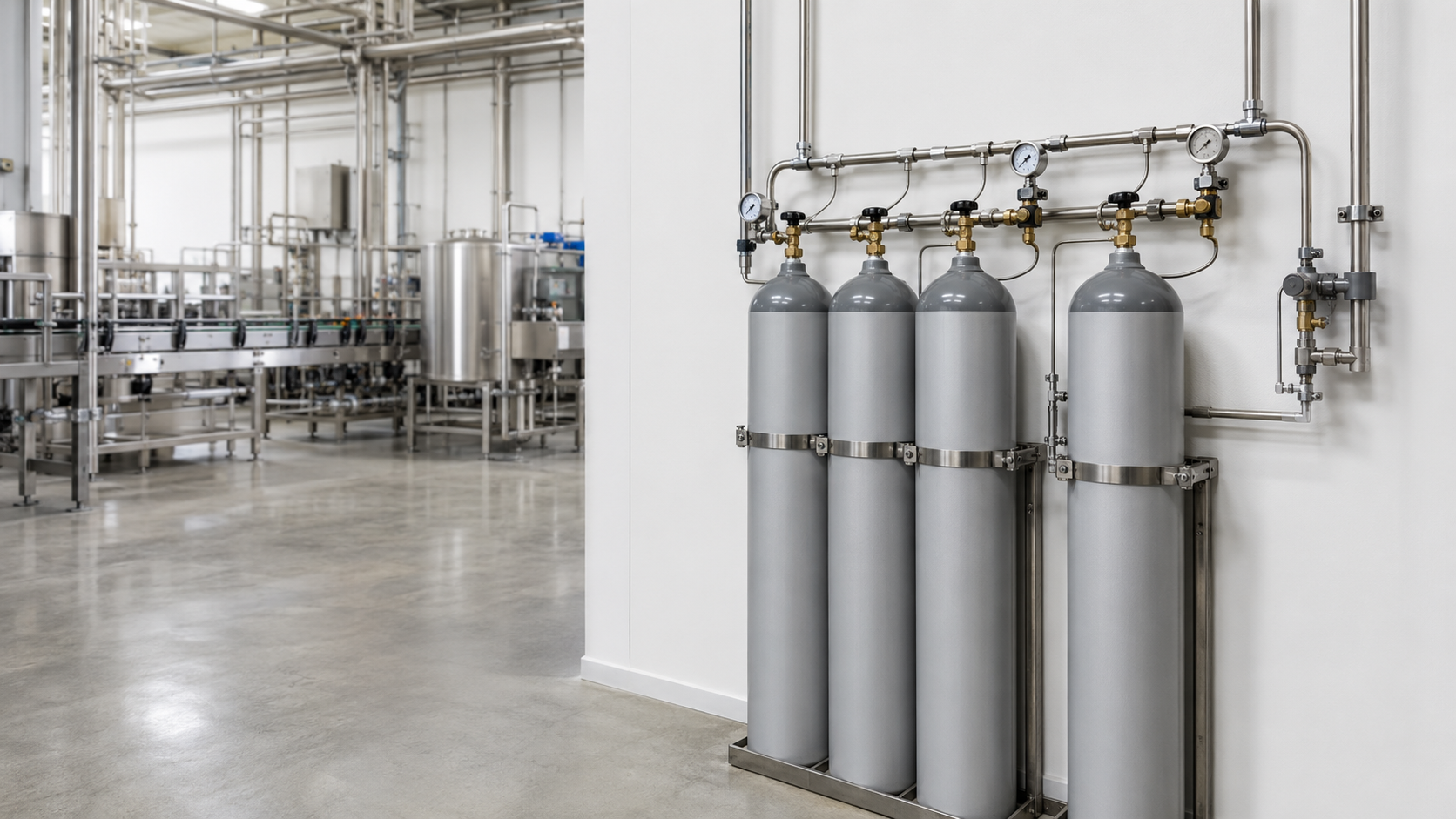
Food Grade CO2 and industrial CO2 may contain the same molecule, but they are not automatically interchangeable.
The decisive difference is not simply the headline CO2 percentage. It is whether the gas has been produced, handled, tested, documented and released under controls appropriate for use in the food chain.
For European food and beverage businesses, Food Grade CO2 should meet the applicable E290 specifications and be supported by traceability, batch documentation, hygienic handling controls and a suitable food-safety management system.
Industrial CO2 may be appropriate for welding, process control, inerting and other technical applications. However, it should not be introduced into food, beverages or food-contact processes unless the supplier has formally qualified it for that use.
Northline Distribution provides food grade gas solutions for European businesses requiring documented sourcing, reliable logistics and supply arrangements aligned with their operational requirements.
Key takeaways
- Food grade CO2 and industrial CO2 are chemically the same substance, but their specifications, controls and approved uses can differ.
- Food grade CO2 used as an additive in the European Union is identified as E290.
- A purity statement such as “99.9% CO2” does not, by itself, demonstrate food-grade suitability.
- Procurement teams should assess impurity limits, source qualification, hygiene controls, traceability and supporting documentation.
- A certificate of analysis should be linked to a defined batch or lot and assessed against the agreed specification.
- Gas used for food processing must be evaluated according to its function as an additive, ingredient or processing aid.
- The lowest unit price does not necessarily produce the lowest total cost of supply.
- Supplier qualification should cover product quality and the resilience of the entire supply chain.
What is Food Grade CO2?
Food Grade CO2 is carbon dioxide supplied under controls appropriate for food and beverage applications.
When carbon dioxide is used as a food additive in the European Union, it is identified as E290. Its use can include carbonation, modified atmosphere packaging and other authorised technological functions.
Food-grade status involves more than concentration. The supply chain must control contamination risks during production, purification, storage, filling, transport and delivery.
A suitable supply arrangement should also provide the documentation needed to establish:
- The identity of the product;
- The applicable specification;
- The production or filling batch;
- Conformity with agreed impurity limits;
- Traceability through the supply chain;
- Appropriate handling and hygiene controls; and
- Procedures for managing non-conforming product.
The European Industrial Gases Association describes food gases as gases supplied to the food industry for use as additives, processing aids or ingredients. These gases may be delivered as compressed gas, bulk liquid, solid dry ice or generated on-site. See the EIGA Guide to the Supply of Gases for Use in Foods, Doc 125/20.
What is Industrial CO2?
Industrial CO2 is carbon dioxide supplied for technical or industrial operations.
Applications can include:
- Welding and metal fabrication;
- Process inerting;
- PH control;
- Water treatment;
- Leak testing;
- Chemical processing;
- Refrigeration;
- Fire suppression;
- Controlled industrial atmospheres.
Industrial grades may have a high CO2 assay. Some may even meet or exceed the headline assay associated with food-grade gas.
That does not make them food grade.
A technical specification may control the impurities that matter for a particular industrial process while omitting substances relevant to food safety, taste, odour or consumer exposure. The production and distribution system may also operate under different hygiene, traceability and change-control requirements.
Businesses sourcing gases for non-food applications can review Northline’s technical gas solutions.
Food Grade CO2 vs Industrial CO2: The essential differences
| Procurement factor | Food Grade CO2 | Industrial CO2 |
|---|---|---|
| Intended use | Food, beverages and food-contact processing | Manufacturing, engineering and technical processes |
| EU designation | E290 when used as a food additive | No food-additive designation |
| Product specification | Includes food-relevant purity and impurity criteria | Based on the requirements of the industrial application |
| Source qualification | Source assessed for food-gas production and contamination risks | Source assessed against the applicable industrial specification |
| Hygiene controls | Food-safety and hygiene controls are expected | Industrial cleanliness and quality controls apply |
| Traceability | Batch or lot traceability through the food supply chain | Traceability depends on the technical specification and contract |
| Documentation | Specification, certificate of analysis or conformity, batch identification and supporting declarations | Technical data and conformity documents appropriate to the industrial use |
| Change control | Changes affecting food safety or conformity should be assessed and communicated | Defined according to the industrial quality agreement |
| Typical applications | Carbonation, modified atmosphere packaging, chilling and food processing | Welding, inerting, treatment, testing and manufacturing |
| Interchangeability | May sometimes be technically suitable for non-food use, subject to system requirements | Should not be assumed suitable for food use |
The commercial risk lies in assuming that a similar purity percentage makes the two grades equivalent.
It does not.
Food additive, ingredient or processing aid?
A procurement specification should define how the gas functions in the customer’s process. This affects the legal and technical assessment.
CO2 as a food additive
A food additive is intentionally added for a technological purpose and becomes, or can reasonably be expected to become, a component of the food.
Packaging gases fall within the food-additive framework. Regulation (EC) No 1333/2008 defines a packaging gas as a gas other than air introduced into a container before, during or after food is placed in that container.
When CO2 is used as an authorised food additive, the E290 specification applies.
CO2 as an ingredient
CO2 acts as an ingredient when it is used in food preparation and remains present in the final product.
Carbonation is the clearest example. The gas becomes part of the beverage and influences its taste, acidity and sensory characteristics.
EIGA notes that EU law does not set separate purity criteria specifically for gases used as ingredients. However, general food-safety and hygiene obligations continue to apply, and the E290 criteria provide a relevant procurement baseline.
CO2 as a processing aid
A processing aid performs a technological function during production but is not intended to have a technological effect in the finished product.
Examples include:
- Cryogenic chilling;
- Freezing;
- Temperature control;
- Certain extraction processes; and
- Process inerting.
Where nitrogen is specified instead of CO₂ for oxygen removal or atmosphere control, our guide explains how industrial nitrogen purging works and where it is commonly used.
Processing aids do not fall under every provision that applies to food additives. However, residues must not present a health risk.
EIGA recommends food-additive quality for gases used as processing aids in contact with food. This provides a prudent specification where the gas can contact the product or leave technically unavoidable residues.
What does E290 compliance require?
Commission Regulation (EU) No 231/2012 establishes specifications for food additives listed under the EU food-additive framework. Carbon dioxide appears under the designation E290.
The following table summarises selected EU specification criteria reproduced in EIGA Doc 126/20. It is not a complete purchasing specification.
| E290 characteristic | European Commission criterion summarised by EIGA |
|---|---|
| Carbon dioxide assay | More than 99% by volume |
| Moisture | Less than 0.05% |
| Carbon monoxide | Less than 10 vppm |
| Oil | Less than 5 mg/kg |
| Acidity | Passes the prescribed test |
| Reducing substances | Passes the prescribed test |
Source: EIGA Minimum Specifications for Food Gas Applications, Doc 126/20, published in 2020, summarising the relevant EU criteria at the date of publication.
Procurement teams should check the current consolidated version of Commission Regulation (EU) No 231/2012 and any requirements applicable in the destination market before approving a commercial specification.
Why “99% pure” is not enough
A CO2 assay only shows how much of the sample is carbon dioxide. It does not fully explain the remaining fraction.
That remaining fraction can contain moisture, oxygen, nitrogen, carbon monoxide, hydrocarbons, oil or source-specific trace compounds. Even very small concentrations can matter if they create:
- A food-safety concern;
- An unwanted taste or odour;
- Process instability;
- Corrosion or equipment problems;
- Customer complaints; or
- Non-conformity with an agreed specification.
A gas described as 99.9% pure could still be unsuitable for a food application if the supplier has not identified and controlled the relevant impurities.
Conversely, a food-grade specification may accept a lower headline assay while applying tighter controls to the impurities that matter.
The correct question is therefore not simply, “What is the CO2 percentage?”
It is:
Does this batch meet the complete specification for its intended food application, and can the supplier demonstrate that conformity?
The European compliance framework
Food Grade CO2 procurement sits within several connected legal and voluntary frameworks.
Regulation (EC) No 178/2002: general food law
Regulation (EC) No 178/2002 establishes the general principles of EU food law.
It places primary responsibility for food-law compliance on food business operators and establishes the basis for traceability. Businesses must be able to identify where relevant products came from and to whom they were supplied.
For gas procurement, this makes lot identification and supply-chain records operational requirements rather than administrative extras.
A traceability system should allow the business to connect:
- The delivered gas;
- The supplier and source;
- The relevant batch or filling record;
- The internal storage system;
- The production line or product affected; and
- Downstream customers where applicable.
Regulation (EC) No 1333/2008: food additives
Regulation (EC) No 1333/2008 governs food additives in the European Union.
It defines food additives, packaging gases, propellants and processing aids. It also sets rules for authorised uses and labelling.
The regulation should be read together with the specifications established under Regulation (EU) No 231/2012.
Regulation (EU) No 231/2012: additive specifications
This regulation establishes identity and purity criteria for authorised food additives, including E290 carbon dioxide.
It provides the legal reference point for the E290 specification. A supplier may operate a tighter internal specification, but it should not substitute a general purity statement for the regulated criteria.
Regulation (EC) No 852/2004: food hygiene
Regulation (EC) No 852/2004 establishes hygiene requirements for food businesses and requires procedures based on Hazard Analysis and Critical Control Point principles where applicable.
For a food-gas supply chain, a hazard analysis may consider:
- Contamination from the CO2 source;
- Cross-contamination in shared equipment;
- Residues from cleaning or maintenance;
- Contamination during cylinder preparation;
- Tanker history and dedicated service;
- Incorrect connection or product mix-up;
- Backflow from the customer’s process;
- Compromised valves or seals; and
- Loss of traceability.
The control plan should reflect the actual delivery format and application.
Regulation (EC) No 1935/2004: food-contact materials
Gas can contact storage vessels, valves, pipework, seals, hoses and process equipment before reaching the food.
Regulation (EC) No 1935/2004 requires food-contact materials not to transfer constituents to food in quantities that could endanger health, cause unacceptable changes to composition or impair sensory characteristics.
Procurement and engineering teams should therefore assess both the gas and the components through which it passes.
ISO 22000 and FSSC 22000
ISO 22000:2018 specifies requirements for a food-safety management system. Organisations throughout the food chain can obtain certification against it.
FSSC 22000 is a food-safety certification scheme that incorporates ISO 22000 with additional programme requirements.
These certifications can provide valuable evidence of structured food-safety controls. They do not replace product-specific qualification, a certificate of analysis or compliance with the law.
Procurement teams should distinguish clearly between:
- A legal obligation;
- A product specification;
- A management-system certification; and
- Voluntary industry guidance.
Treating them as interchangeable creates gaps in supplier approval.
The Food Grade CO2 supply chain
Food Grade CO2 conformity depends on every stage between the source and the point of use.
1. Source qualification
Commercial CO2 can originate from fermentation, ammonia production, hydrogen production, natural deposits and other processes.
The source matters because each process presents a different impurity profile.
A supplier qualification programme should assess:
- The original production process;
- Raw-material variability;
- Purification stages;
- Likely source-specific contaminants;
- Monitoring methods;
- Abnormal operating conditions;
- Change-control procedures; and
- The response to an out-of-specification result.
A generic certificate showing the final CO2 concentration does not replace source qualification.
2. Purification and testing
Testing should reflect the identified risks.
A strong control plan combines:
- Routine release testing;
- Periodic testing for lower-frequency impurities;
- Validated analytical methods;
- Defined sampling procedures;
- Calibrated equipment;
- Specification limits; and
- Escalation rules for non-conforming results.
Not every cylinder must undergo a full laboratory analysis. In many systems, defined batches are tested and released under a documented quality-control programme.
The relevant question is whether the sampling and release system represents the supplied product reliably.
3. Filling and container preparation
Cylinder history and condition can affect product integrity.
Controls may include:
- Correct product identification;
- Pre-fill inspection;
- Valve examination;
- Residual pressure checks;
- Prevention of backflow;
- Segregation of non-conforming containers;
- Controlled evacuation or preparation;
- Post-fill inspection; and
- Batch identification.
EIGA Doc 125/20 provides industry guidance covering pre-fill inspection, filling, post-fill checks, quality control, traceability and delivery.
4. Bulk transport and storage
Bulk supply adds different risks.
The qualification should cover:
- Tanker service history;
- Tanker cleanliness;
- Loading controls;
- Transfer connections;
- Seals;
- Delivery records;
- Storage-tank condition;
- Maintenance;
- Pressure management; and
- Emergency delivery procedures.
The customer also controls part of the chain. A compliant delivery can still be compromised by an unsuitable storage tank, contaminated connection or poorly maintained distribution system.
5. Receiving and point-of-use controls
Receiving procedures should confirm:
- Supplier identity;
- Product and grade;
- Batch or lot number;
- Container or tanker identification;
- Seal condition where applicable;
- Documentation;
- Delivery quantity; and
- Connection compatibility.
The gas should then remain segregated and identifiable until use.
Documentation procurement teams should request
The required document set depends on the application, delivery format and customer risk assessment.
A practical Food Grade CO2 file normally includes the following.
| Document | What it should demonstrate |
|---|---|
| Product specification | Agreed assay, impurity limits and test requirements |
| Certificate of analysis | Results for a defined batch or lot |
| Certificate of conformity | Formal confirmation that the supplied product meets the agreed specification |
| Safety data sheet | Classification, handling, storage and emergency information |
| Batch or lot identification | Connection between the gas, filling event and quality records |
| Food-grade declaration | Confirmation of suitability for the declared food application |
| Traceability information | Source-to-customer supply-chain records |
| Management-system certificates | Scope and current status of relevant quality or food-safety certification |
| Change-control procedure | How material changes will be assessed and communicated |
| Non-conformance procedure | Quarantine, investigation, notification and corrective-action controls |
| Recall or withdrawal procedure | Ability to identify and manage affected deliveries |
| Transport documentation | Product, quantity, equipment and delivery identification |
A certificate should be checked, not merely collected.
Confirm that:
- The product name and grade are correct;
- The certificate applies to the delivered batch;
- The results match the agreed limits;
- The analytical units are clear;
- The document is authorised;
- The date is relevant; and
- Any exceptions or qualifications have been resolved.
Choosing between cylinders, bundles and bulk supply
The delivery format should follow consumption, peak demand, available space and continuity requirements.
| Supply format | Best suited to | Advantages | Limitations |
|---|---|---|---|
| Individual cylinders | Low or intermittent consumption | Flexible, limited infrastructure and simple deployment | Higher handling frequency and greater risk of changeover interruption |
| Cylinder bundles | Moderate or variable consumption | Fewer connections, greater capacity and easier changeover management | Requires suitable handling space and equipment |
| Bulk liquid CO2 | High and stable consumption | Lower handling intensity and support for continuous production | Requires storage infrastructure, telemetry and delivery planning |
| On-site generation | Selected continuous applications | Reduced dependence on delivered volumes | Requires capital investment, maintenance and rigorous product-quality controls |
A practical decision framework
Consider five factors before selecting a format:
- Average consumption: How much CO2 does the site use each week or month?
- Peak demand: Can the system support short periods of high withdrawal?
- Criticality: What is the cost of a supply interruption?
- Site capability: Is there space, access and technical capacity for bulk storage?
- Growth: Will the current format remain economical as production expands?
A growing beverage plant may begin with cylinders, move to bundles and later justify bulk storage. The specification and traceability requirements should remain consistent during each transition.
Real-world applications and purchasing priorities
| Application | Role of CO2 | Key procurement priorities |
|---|---|---|
| Carbonated beverages | Ingredient | Sensory quality, impurity control, continuous availability and batch traceability |
| Brewing | Carbonation, tank blanketing and transfer | Oxygen control, flavour protection, reliable pressure and hygienic handling |
| Modified atmosphere packaging | Food additive or packaging gas | Correct gas specification, mixture accuracy and consistent delivery |
| Meat and poultry packaging | Packaging atmosphere | Food Grade CO2 conformity, mixture control and stable supply |
| Chilling and freezing | Processing aid | Food-contact suitability, capacity planning and safe handling |
| Dry ice for food logistics | Cooling medium | Food-grade source, hygienic production, packaging and sublimation planning |
| Extraction | Processing aid | Impurity profile, process compatibility and documented source control |
| Bulk ingredient storage | Inerting or atmosphere control | Food-contact suitability, system integrity and continuity |
The same gas can perform different functions across one facility. Procurement should not assume that a single generic specification covers every use.
Supplier qualification: a five-part framework
A structured supplier assessment should evaluate more than the product certificate.
1. Product conformity
Confirm:
- The agreed grade;
- Applicable regulatory specification;
- Impurity limits;
- Analytical methods;
- Batch-release process; and
- Document availability.
2. Food-safety controls
Review:
- Hazard analysis;
- Hygiene procedures;
- Contamination controls;
- Container preparation;
- Training;
- Audit findings; and
- Corrective-action management.
3. Traceability and change control
Determine whether the supplier can:
- Trace each batch to its source;
- Connect filling and testing records;
- Identify affected deliveries;
- Notify customers of material changes; and
- Support a rapid investigation.
4. Supply resilience
Assess:
- Number and location of qualified sources;
- Normal lead time;
- Minimum order requirements;
- Available delivery capacity;
- Contingency stock;
- Backup logistics;
- Emergency response; and
- Allocation procedures during shortages.
5. Commercial governance
Define:
- Forecast responsibilities;
- Service levels;
- Document turnaround;
- Price-adjustment mechanisms;
- Complaint management;
- Review frequency; and
- Escalation contacts.
Northline’s European sourcing and distribution model is designed around coordinated sourcing, quality documentation, traceability and dependable logistics for professional B2B customers.
Supplier qualification scorecard
A weighted scorecard helps procurement teams compare suppliers consistently.
| Assessment area | Example weighting |
|---|---|
| Product conformity and analytical controls | 25% |
| Food-safety and hygiene systems | 20% |
| Traceability and change management | 15% |
| Supply continuity and logistics | 20% |
| Documentation and communication | 10% |
| Commercial terms and total cost | 10% |
The weighting should reflect the site’s risk profile.
A high-volume beverage plant may assign more weight to continuity. A contract packer serving several retailers may place greater emphasis on documentation, audit access and change notification.
A very low price should not compensate for a critical food-safety or traceability failure.
Cost implications: evaluate total cost of supply
The quoted price per kilogram or cylinder is only one cost component.
A more complete calculation includes:
- Cylinder or equipment rental;
- Delivery charges;
- Minimum order quantities;
- Unused residual product;
- Cylinder handling;
- Changeover labour;
- Storage requirements;
- Documentation administration;
- Emergency deliveries;
- Production interruptions;
- Rejected batches;
- Supplier audits; and
- Transition costs.
The cost of interruption
CO2 shortages can stop carbonation, packaging, chilling or transfer operations.
A procurement team should estimate:
Hourly production contribution × expected downtime + restart losses + labour disruption + expedited supply cost
This calculation helps determine the value of backup stock, dual sourcing or telemetry.
The least expensive supply contract can become the most costly option if it leaves the plant exposed to repeated interruptions.
The cost of weak documentation
Missing or inconsistent documentation also creates expense.
It can delay:
- incoming-goods release;
- customer approval;
- audits;
- export documentation;
- complaint investigations; and
- product disposition decisions.
Document quality should therefore form part of the commercial evaluation.
Three practical procurement scenarios
Scenario 1: A beverage producer replacing its CO2 supplier
A beverage plant receives a competitive offer for gas described as “99.9% pure CO2.”
The assay appears suitable, but the quotation does not state E290, identify impurity limits or describe batch traceability.
The correct response is not immediate rejection or acceptance. Procurement should request:
- The complete food-grade specification;
- A representative certificate of analysis;
- Source and filling controls;
- Relevant food-safety certifications;
- Change-notification procedures;
- Delivery contingency arrangements; and
- Confirmation of suitability for carbonation.
Only then can the plant compare the offer with the incumbent supply on a like-for-like basis.
Scenario 2: A food packer moving from cylinders to bulk
A modified atmosphere packaging facility is increasing production. Frequent cylinder changes now create handling pressure and interruption risk.
Bulk CO2 may reduce handling, but the business must assess:
- Annual and peak consumption;
- Storage-tank requirements;
- Site access;
- Tanker scheduling;
- Telemetry;
- Backup supply;
- Maintenance responsibility;
- Gas recovery or venting; and
- The effect of downtime during installation.
The decision should be based on total operating cost and resilience rather than volume alone.
Scenario 3: A distributor launching a Food Grade CO2 range
A regional distributor wants to add Food Grade CO2 under its own brand.
The commercial plan must address more than label design. It should define:
- The legal entity responsible for placing the product on the market;
- Product specifications;
- Approved manufacturers and fillers;
- Cylinder ownership and inspection;
- Labels and batch identification;
- Certificates and traceability;
- Complaint and recall responsibilities;
- Territorial logistics; and
- Minimum production quantities.
Northline supports qualified distributors evaluating private-label gas solutions with European sourcing, documentation and distribution requirements.
Common Food Grade CO2 procurement mistakes
Buying on purity percentage alone
A headline assay does not describe the complete impurity profile or supply controls.
Accepting a generic certificate
A certificate that cannot be linked to the delivered batch provides limited traceability value.
Treating ISO certification as product approval
Management-system certification supports confidence in the supplier’s processes. It does not prove that a particular batch meets the agreed E290 specification.
Ignoring the CO2 source
Different source processes can present different contaminants and operating risks.
Using industrial cylinders in a food process
An industrial cylinder may have an unsuitable service history, preparation method or documentation trail.
Overlooking customer-side equipment
The gas can become contaminated after delivery through tanks, valves, hoses, regulators or backflow from the process.
Failing to define change notification
A supplier may change the source, filling location, analytical method or logistics route. The contract should state which changes require advance assessment.
Qualifying only one source
A single-source model can expose the business to production outages, maintenance shutdowns and transport disruption.
Selecting supply format by current demand only
A format that works today may become inefficient or operationally fragile as production increases.
Comparing quotations that cover different scopes
One offer may include rental, testing and delivery while another excludes them. Normalise the commercial scope before making a decision.
EU and UK procurement considerations
The United Kingdom retained a substantial body of EU-derived food law after leaving the European Union. However, EU and UK requirements can change separately.
Businesses supplying both markets should maintain a regulatory register covering:
- The EU requirements applicable in member states;
- The rules applying in Great Britain;
- Any separate requirements in Northern Ireland;
- Destination-country labelling;
- Customer-specific standards; and
- Changes to recognised specifications.
The UK legislation database includes the retained specification for E290 carbon dioxide.
Regulatory status should be confirmed when approving a new supplier, entering a new market or changing the gas application.
Emerging procurement priorities
Greater source transparency
Buyers increasingly want to understand where CO2 originates, how it is purified and how source changes are controlled.
Stronger contingency planning
Food manufacturers are placing more emphasis on backup sources, buffer stock, delivery flexibility and documented allocation procedures.
Better digital traceability
Electronic certificates, batch records and shipment data can reduce document delays and improve investigation speed.
Closer quality and procurement alignment
Supplier approval works best when procurement, quality, engineering and operations review the supply arrangement together.
More attention to carbon data
Customers may request product carbon-footprint information or evidence concerning recovered CO2 sources. Environmental data should remain separate from food-grade conformity: a lower-carbon source must still meet the required food-safety and quality controls.
Frequently asked questions
Is Food Grade CO2 the same as industrial CO2?
The molecule is the same, but the grades are not automatically interchangeable. Food-grade CO2 is supplied under specifications and controls appropriate for food use, including impurity limits, hygiene and traceability requirements. Industrial CO2 is supplied for technical applications and should not be assumed suitable for food contact.
What purity is Food Grade CO2?
The EU E290 specification requires a carbon dioxide assay of more than 99% by volume and includes additional impurity criteria. The assay alone does not establish food-grade suitability.
Is 99.9% CO2 always food grade?
No. A 99.9% purity statement does not identify all impurities or demonstrate food-grade source control, hygienic handling, batch traceability or regulatory conformity.
What does E290 mean?
E290 is the European food-additive designation for carbon dioxide. It is used for authorised technological purposes such as packaging and carbonation.
Can industrial CO2 be used for beer or soft drinks?
It should not be used unless the supplier has formally qualified and documented the gas for the intended food or beverage application. A technical-grade label or purity percentage is not sufficient.
Is beverage-grade CO2 different from Food Grade CO2?
“Beverage grade” is often used commercially for CO2 intended for carbonation. Buyers should still examine the actual specification, impurity limits, sensory controls, traceability and applicable E290 conformity rather than relying on the description alone.
Do I need a certificate of analysis for every cylinder?
Not necessarily. Suppliers often release a defined batch based on representative testing under a documented sampling system. However, the delivered cylinders should remain traceable to the released batch.
Is ISO 22000 legally required for a Food Grade CO2 supplier?
ISO 22000 is a certifiable food-safety management standard, not a universal statutory requirement. It can provide useful evidence of structured controls but does not replace legal compliance or product-specific qualification.
What documents should a Food Grade CO2 supplier provide?
The appropriate package can include a product specification, certificate of analysis or conformity, safety data sheet, batch identification, food-grade declaration, traceability records and relevant management-system certificates.
How should a business choose a Food Grade CO2 supplier?
Evaluate product conformity, source qualification, food-safety controls, documentation, traceability, supply continuity, delivery capacity and total cost. The supplier should be able to explain how it manages non-conforming batches and disruptions.
Conclusion
The difference between Food Grade CO2 and industrial CO2 cannot be reduced to a purity percentage.
Food-grade procurement requires a documented chain of control. The source, impurity profile, filling process, containers, logistics, batch records and point-of-use system all influence suitability.
A robust procurement decision should answer four questions:
- Is the gas specified correctly for its intended use?
- Can the supplier demonstrate conformity for each supplied batch?
- Is traceability maintained throughout the supply chain?
- Can the supply arrangement support production during normal and disrupted conditions?
Businesses that answer these questions before approving a supplier reduce compliance risk, prevent avoidable interruptions and create a more dependable basis for long-term supply.
Discuss your Food Grade CO2 requirements
Northline Distribution works with European manufacturers, food producers and distributors seeking certified gas sourcing, clear documentation and dependable B2B logistics.
Request a supply review or quotation covering your required grade, volume, delivery format, destination markets and continuity requirements.